
Home staging ROI in BC: estimate investment and value uplift

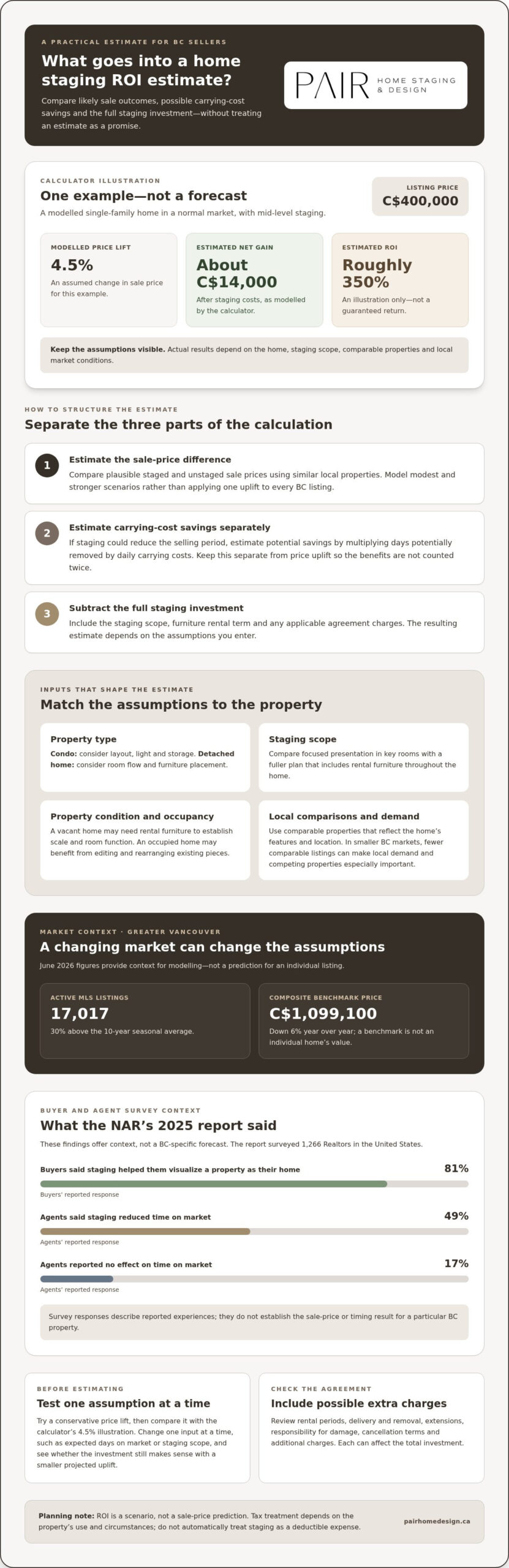
Staging can make financial sense, but the return depends on more than the final sale price. In one calculator example, a $400,000 single-family home with mid-level staging in a normal market is modelled with a 4.5% price lift, an estimated net gain of about $14,000 after staging costs and an estimated ROI of roughly 350%. Treat that as an illustration, not a forecast for every BC property.
It’s natural to weigh the cost of staging against the possibility of a stronger sale. Property type, presentation and local market conditions all affect the calculation. A home staging ROI calculator for BC can help you organize those variables into a practical estimate, not a guaranteed return.
This article explains how staging scope and carrying costs factor into your estimate, why a condo and a detached home may produce different results, and how local market conditions shape the decision. You’ll have a clearer framework for deciding whether staging fits your selling goals.
Key Takeaways
- Build a more useful estimate by weighing the asking price alongside property type, staging scope and current local market conditions.
- Separate potential sale-price uplift from carrying-cost savings to see how each could affect the overall return.
- Compare staging investment with a realistic unstaged sale scenario, rather than assuming presentation guarantees a higher offer or faster sale.
- Learn how a tailored Home Consult or staging plan can help identify which rooms and details deserve attention before listing.
Calculator inputs: listing price, property type, staging level, and market conditions
Start with a realistic listing price, then compare staged and unstaged scenarios using similar local properties. A 1% increase on a C$400,000 listing equals C$4,000. A home staging ROI calculator for BC sellers can show how estimated uplift compares with the investment, but it isn’t a promise of sale proceeds.
Property type shapes what buyers notice. In a condo, layout, light and storage can influence the impression; in a detached home, room flow and furniture placement may matter more. In smaller BC markets, fewer comparable listings can make local demand and competing properties especially important. Choose comparisons that reflect your home’s features and location.
Staging level also changes the estimate. Compare focused presentation in key rooms with a fuller plan involving rental furniture throughout the home. Include the staging cost and rental term, then estimate any reduction in days on market separately. According to the NAR’s 2025 staging report, 81% of buyers said staging helped them visualize a property as their home. The report also found 49% of agents said staging reduced time on market, while 17% reported no effect.
Market conditions influence likely sale price and timing. Greater Vancouver had 17,017 active MLS listings in June 2026, 30% above its 10-year seasonal average; its composite benchmark price was down 6% year over year. In a slower market, compare presentation with nearby listings and model carrying costs. This approach to calculating home staging ROI in BC is most useful when market assumptions reflect the listing’s area.
For tax purposes, don’t automatically treat staging as a deductible expense. Tax treatment depends on the property’s use and circumstances, so include the expense in your estimate unless you receive advice that establishes otherwise.
Review any staging agreement for rental periods, delivery and removal, extensions, responsibility for damage, cancellation terms and additional charges. Each can affect the total investment.
To estimate ROI, compare plausible staged and unstaged sale prices, add any reasonable carrying-cost savings, then subtract the staging investment.
Staging investment and estimated value uplift
Estimate the potential sale-price difference separately from the staging investment and any carrying-cost savings. A calculator is most useful when its assumptions reflect the home and local market.
Limits of Directional ROI Estimates
An ROI estimate is a planning scenario, not a prediction of your sale price. Buyer demand, comparable listings, presentation and timing all influence the outcome. A calculator may show a strong return based on assumptions that don’t fit your property. Use it to compare scenarios, keeping the estimated price change separate from possible savings.
What-If Estimate Testing
What-if testing compares alternative assumptions to show how they change the estimated return. For example, model a conservative price lift, then compare it with the calculator’s 4.5% illustration for a C$400,000 single-family home. Change one input at a time, such as expected days on market or staging scope. This helps a seller see whether the investment still makes sense when the projected uplift is smaller.
Sale-Price Uplift Across BC Markets
There’s no reliable uplift figure for every Vancouver or BC listing. A broad range isn’t a BC-specific forecast. For a local estimate, compare similar properties and current buyer demand, then model modest and stronger scenarios instead of applying one percentage to every home.
Vacant properties may need rental furniture to establish scale and room function; an occupied home may benefit more from editing and rearranging existing pieces. Estimate the full investment using the staging scope and rental duration. For savings, multiply the days potentially removed from the selling period by daily carrying costs, then subtract staging investment. Keep that calculation distinct from price uplift so the two benefits aren’t counted twice. A tailored home staging plan can help align the presentation with the property’s needs.
Vancouver home-staging return on investment
Vancouver ROI depends on whether presentation changes the sale outcome enough to offset the investment. Greater Vancouver’s composite benchmark price was C$1,099,100 in June 2026, but a benchmark isn’t an estimate for an individual listing. Compare the property with similar local sales, then model likely sale proceeds with and without staging. Subtract the staging investment from the difference to estimate price-related return.
Buyer response offers context, not a guaranteed uplift. In the NAR’s 2025 staging report, 29% of agents said buyers offered 1-10% more for staged homes. The report surveyed 1,266 Realtors in the United States, so its findings aren’t a Vancouver-specific forecast. For a local seller, the useful question is whether staging helps buyers picture the home’s layout, light and everyday use beside competing inventory.
Other industry figures need the same care. IAHSP reports that 69% of professionally staged properties sell for 4% to 18% over list price. That finding describes reported outcomes, not the actual increase staging would create for a particular Vancouver property. Asking prices, neighbourhood demand, condition and competing listings all shape the comparison. Don’t treat an over-list result as proof that staging caused the entire difference.
Room choices can make the investment more intentional. According to the NAR’s 2025 report, agents identified the living room as the most commonly staged room, at 91%; 34% of buyers said the primary bedroom most influenced their decision. These figures can guide where to focus, but the home’s own layout matters. A bright living area may benefit from edited furniture placement, while an awkward bedroom may need clearer scale and flow.
For a Vancouver estimate, start with a conservative scenario. Compare local properties with similar features, estimate a plausible difference in sale price with staging, and subtract the staging investment. Add carrying-cost savings only if you have a reasonable basis for expecting a shorter selling period. Sellers and agents can then assess whether the projected net return supports the planned presentation, rather than relying on a headline percentage.
How is home staging ROI calculated in British Columbia?
Calculate return by comparing the staged scenario with a realistic unstaged baseline. Use this formula: ROI = (estimated price uplift + carrying-cost savings − staging cost) ÷ staging cost × 100. The result expresses net return as a percentage of the investment. Keep price uplift and time-related savings separate before combining them.
To estimate the sale-price difference, first consider what the property might sell for without staging, then compare it with a staged estimate. Use comparable homes with similar locations, property types and condition. Avoid applying a broad percentage to every listing: a detached home, condo and townhouse may each face different buyer expectations and competing inventory.
Next, estimate carrying-cost savings from any change in days on market. The calculator’s typical estimated reduction is 7-21 days, but use a scenario that fits local conditions. Add the relevant monthly mortgage, tax, insurance and utility expenses, then calculate the cost associated with the days potentially saved. The seller’s actual carrying expenses depend on the property.
Subtract the staging investment only once. Don’t count a shorter selling period twice by including it in both the projected sale price and carrying-cost savings. Test a conservative case with little price movement, then compare it with a stronger-uplift scenario. If the estimate depends entirely on a large sale-price increase, the investment is less resilient than one supported by both potential price and time savings.
Use current BC comparables and the listing’s real expenses to make each input relevant. Then review the presentation scope against the rooms buyers need to understand. Plan your home staging around the property’s layout and selling goals.
Pair Home Design: Home Staging
Pair Home Design helps sellers prepare a thoughtful presentation, arranging rooms to feel welcoming, balanced and easy to understand. Home Staging can support vacant or lived-in properties, while Home Styling can refine the look and flow of everyday spaces. If you’re unsure what scope makes sense, a Home Consult can identify where presentation changes may have the clearest impact.
Agents preparing a property for market can also explore The Agent’s Edge. The right approach depends on the home’s condition, existing furnishings and the impression it needs to create for buyers. A considered plan connects your ROI assumptions with practical decisions about how each space is presented.
Contact Pair Home Design to discuss staging or styling for your property.
Turn your estimate into a thoughtful listing plan
A home staging ROI calculator for BC can help organize your thinking, but the next step is turning its assumptions into choices for your property. Consider which rooms need a clearer purpose, whether the current furnishings support the home’s flow, and what buyers should notice first. A considered presentation can make a listing feel coherent, welcoming and true to the home.
Use your estimate as a planning guide, not a promise of a particular sale result. Pair Home Design can help you explore an approach that suits your property and selling goals, whether you’re preparing to list or refining how your spaces come together.
For a conversation about your home and next steps, contact Pair Home Design. A clear plan can help you move towards listing with confidence.
Frequently Asked Questions
The Verdict: Is Staging Worth It?
Staging is worth considering when a home’s layout, scale or function may be hard to understand during a viewing. For example, defining a dining area in an open-plan condo can help buyers see how the space works. If an occupied home already feels clear and inviting, focused Home Styling may make more sense than staging every room. Match the scope to your selling priorities.
Do Staged Homes Sell Faster in Canada?
Staging can help buyers understand a home more quickly by clarifying room purpose, furniture scale and circulation. That can support stronger first impressions in listing photos and during showings. The NAR’s 2025 report surveyed US real estate professionals, so its findings should not be treated as a Canada-wide sales timeline. For a Canadian listing, consider local competition and how clearly the home presents.
Is Staging Expensive?
Staging can be a significant selling expense, especially when a vacant property needs furnishings in several rooms. The scope, existing furniture, property size and rental period all affect the investment. A smaller, targeted presentation may suit a home that already has useful furnishings. Focus your estimate on the rooms most likely to shape a buyer’s impression, rather than assuming every space needs the same treatment.
What if my estimates are off?
Revisit your assumptions instead of relying on a single projected outcome. Build a lower-uplift scenario, then see how the result changes if the home takes longer to sell or needs a different staging scope. For example, test whether the plan still fits your budget if another living area needs attention. This helps reveal which assumptions matter most before you commit.
What is the average cost of home staging in BC?
No single average usefully describes every BC home staging project. The investment depends on property type, whether it’s occupied or vacant, which rooms are included, furnishings needed and the rental period. Pair Home Design tailors its project scope to the property. Request a quote to discuss what presentation plan fits your home.
How does staged versus unstaged time on market compare in British Columbia?
Broad estimates put unstaged homes at 30-60+ days on market and staged homes at 15-25 days. These figures offer a general comparison, not a timeline for every BC listing. A condo competing with similar inventory may move differently from a detached home in a smaller market. Compare properties with similar locations, type and price range to make the timing context more useful.